

Action Audit
Automotive Industry

Audits in the
Automotive Industry

VDA 6.3, VDA 6.5, TISAX - specialized online audits for suppliers in the automotive industry

Automotive Industry
Automotive Industry
Automotive industry is a peculiar part of the production industry. It is characterized by its variety of products and services, from semi-finished products and small elements, through advanced hardware, to fully finished cars. The automotive industry is defined by surprisingly fierce competition - manifested in e.g. in newer and newer car models, released each quarter.Operating in such complicated and competitive branch of the market requires using the highest standards of quality, implementing rules of continuous improvement and carrying out standard and process audits.
Automotive Industry

Audits used in the automotive industry

5S and 6S audits

- are an invaluable tool in every factory, as well as in every smaller production plant, as it is an extremely effective tool for controlling all production and production-related areas for most medium and large-scale organizations. Find out more

Layered Process Audits (LPA)

- are types of process auditing with varying frequency of execution that is carried out at many levels of the organization, from a process engineer to a plant director. Due to their high effectiveness, LPA audits have become a commonly used standard in manufacturing companies. Find out more

Safety Audits (HSE)

- apart from appropriate training, taking care of the safety culture, maintenance and modernization of machines and devices, safety audits are one of the most effective tools when it comes to ensuring and maintaining the highest standards of work safety in a production plant. Find out more

VDA 6.3 Audits

- a German quality management standard created specifically for the automotive industry. It defines process audit requirements for suppliers of German OEMs such as Volkswagen, BMW, and Mercedes-Benz. Read more on the blog

VDA 6.5 Product Audits

- a product audit standard from the German Association of the Automotive Industry (VDA). It evaluates whether finished products meet agreed specifications and customer requirements — a common requirement for Tier 1 and Tier 2 suppliers to German OEMs.

IATF 16949 Internal Audits

- the global quality management system standard for the automotive industry, built on ISO 9001 and required by most OEMs worldwide. IATF 16949 mandates regular internal audits covering process control, product conformity, and supplier management — all fully supported in Action Audit. See ISO audit software

Action Audit for the automotive industry
Action Audit for the automotive industry
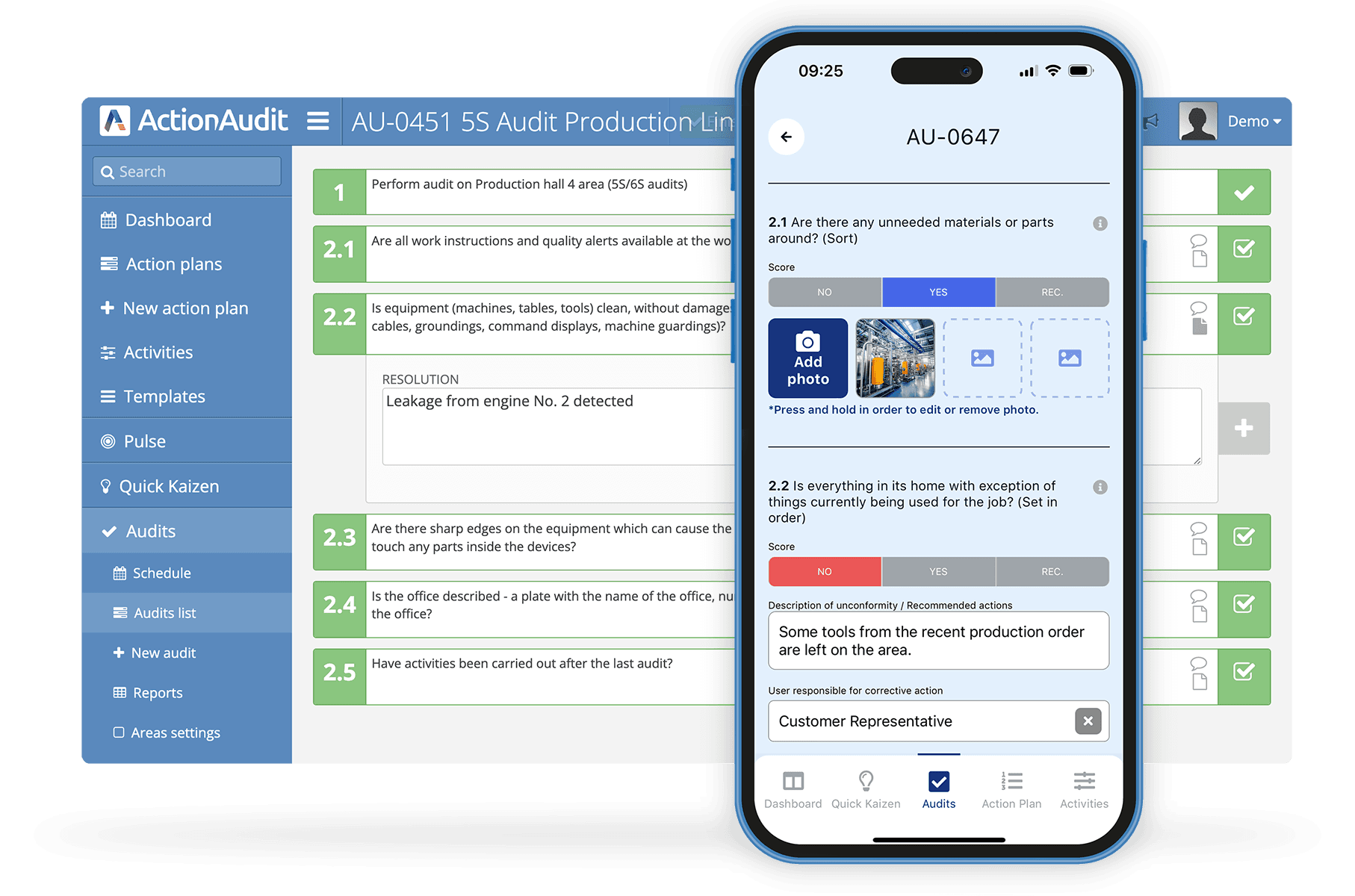
From the start, Action Audit has been used by the producers in the automotive industry in Poland, Germany, Italy and other countries, in which the automotive industry is highly developed.The Action Audit, available in the Action Plan program, provides many tools necessary in the automotive industry. One could even say, that Action Audit has been optimized specifically for its processes.Whether you need to run 5S audits, Layered Process Audits (LPA), Safety Audits, or IATF 16949 and VDA 6.3/6.5 internal audits — Action Audit gives you a single, fully configurable platform to manage them all.
Action Audit for the automotive industry

Key benefits of using Action Audit in the automotive industry

Overall improvement of the quality of the auditing process - transparent scheduling, advanced configuration options, automatic assigning of auditors and addressing of corrective actions, combined with accurate real time reports, result in an overall improvement in the quality, transparency and reliability of the audit process.

Time saving - the information obtained from the current users of the application shows that they achieve between 60 and 80 percent savings on time they previously spent on servicing the auditing process.

Greater team involvement - having a tool with which auditors can carry out an audit from a computer, a tablet or a phone, and people responsible for corrective actions have access to comprehensive information about any inconsistencies, the involvement of the entire staff is increased and the effectiveness of interdepartmental cooperation is improved.

Secondary benefits - Having a properly planned and rigorously enforced system of auditing, it is impossible not to mention a number of secondary benefits, including: improved product quality, fewer complaints, improved key production indicators and increased customer satisfaction.

How to run Action Audit in 3 steps?

Step 1

Click on the link below and fill out a short form in which we will ask you to present a few basic parameters regarding audits in your company.

Step 2

One of our specialists will contact you to arrange an online meeting to see how Action Audit will work in your organization.

Step 3

Based on the information from the form and the meeting, we will prepare an Action Audit especially for you and make it available for free testing for 30, 45, or even 60 days!

Create account now

or

Contact Sales